
Saloua Raouda Choucair: The Pioneer Elevating Arab Abstract Art Through Innovation and Heritage
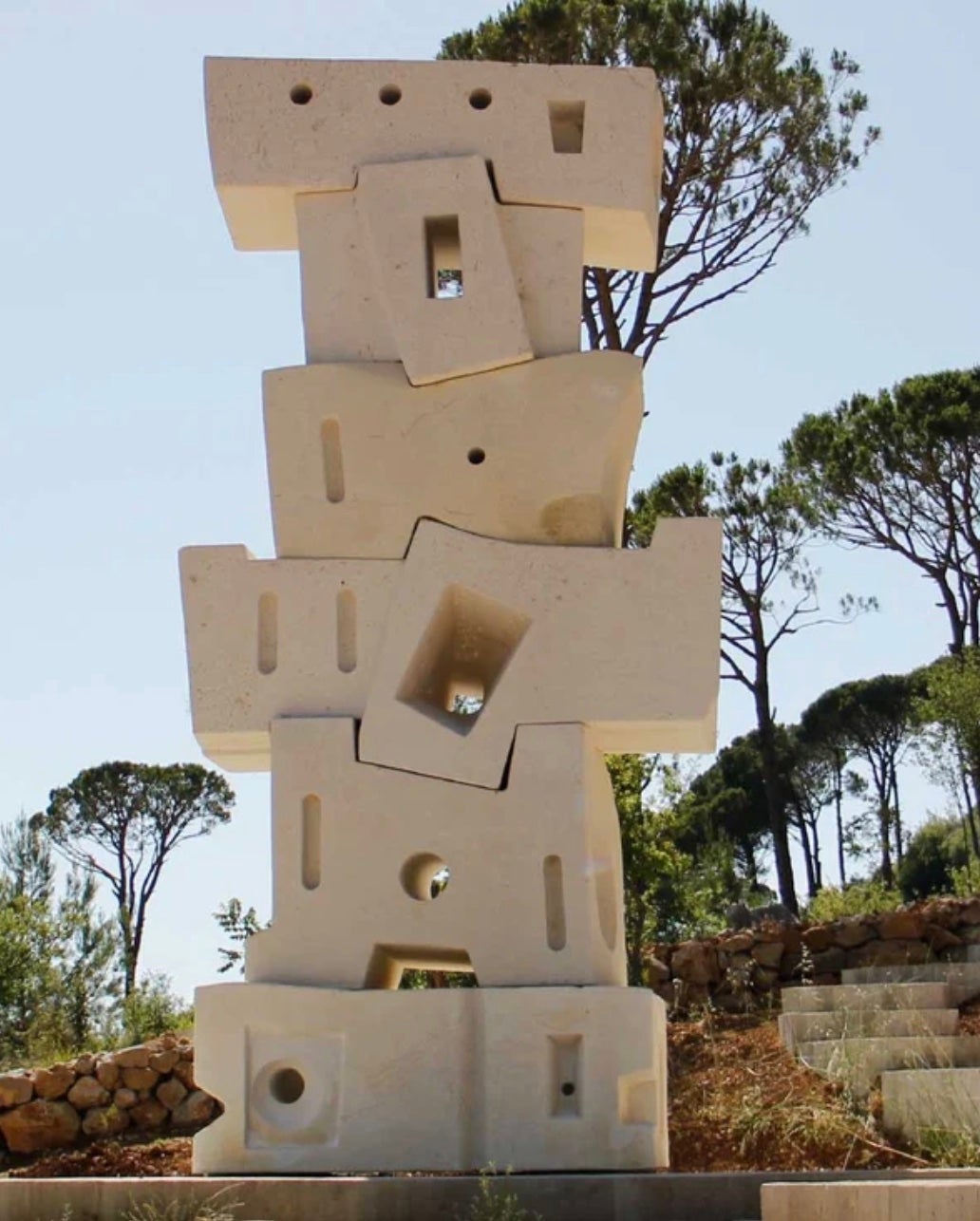
Saloua Raouda Choucair, a prominent figure in Arab modernism, has solidified her status as an avant-garde artist and the mother of Arab abstractionism. Born in Beirut, she devoted most of her life to nurturing a unique artistic voice, bridging diverse cultures, periods, and ideologies through her innovative abstraction. Her legacy has recently been honored with the establishment of a museum in the Lebanese mountains, dedicated to preserving her extensive oeuvre, which comprises over 500 works, including monumental sculptures and intricate geometric paintings. This museum, which opened to the public in July 2024, is managed by her daughter, Hala Choucair.
A Unconventional Path to Art
Choucair’s journey into the realm of art was far from traditional. Initially focused on natural sciences, her academic pursuits greatly influenced her artistic development throughout her life. It was not until her early thirties that she began her formal art education under the tutelage of renowned impressionist painter Omar Onsi. However, it was her travels that profoundly impacted her artistic vision.
A pivotal trip to Cairo and Alexandria in 1944 exposed her to the grandeur of Islamic architecture, characterized by intricate patterns and geometric forms. This experience left a lasting impression on her, prompting her to explore abstraction—a significant theme in her work.
Cross-Disciplinary Exploration
Choucair’s intellectual curiosity was apparent as she delved into various subjects such as physics, mathematics, philosophy, and Arabic poetry. She was captivated by the relationship between form and thought. This fascination echoed the principles of Islamic art, which often transcends figurative representation, allowing her to experience and express the unspoken. Such a philosophical underpinning granted her the freedom to investigate art beyond its traditional confines, focusing on the geometry of nature and the metaphysical aspects of space and form.
Artistic Development in Paris
Choucair’s artistic evolution took her to Paris, where she studied at the École Nationale Des Beaux-Arts and worked in the studio of the respected artist Fernand Léger. In the vibrant European art scene, she fine-tuned her concepts and began to create a fusion of Western modernism with her deep appreciation for Arab-Islamic culture. Her work began to reflect a visionary synthesis of different artistic traditions, showcasing the vast potential of abstraction while remaining firmly rooted in her cultural heritage.
A Fusion of Science, Culture, and Art
The intersection of scientific precision and cultural depth played a crucial role in Choucair’s artistic success. Her work is characterized by a meticulous exploration of structure and form, heavily drawing on the geometric principles inherent in Islamic design. Nonetheless, her approach is not merely nostalgic; it is forward-looking. Choucair sought to create a bridge to the future through her abstraction, embracing both rationality and organic growth.
Choucair’s innovative spirit continues to resonate within the contemporary art world. Her work serves as a compelling testament to the possibilities of art to transcend boundaries and foster connections among diverse cultures. The newly unveiled museum dedicated to her creative legacy stands as a pivotal site for both appreciation and education, celebrating the transformative power of art.
As reported by www.savoirflair.com, Choucair’s impact on the art scene endures, inspiring future generations of artists. Through her unique lens, she invites viewers to reconsider how art can reflect the intricate tapestry of cultural heritage.
In a world increasingly defined by globalization, Choucair’s work underscores the importance of preserving individual cultural narratives while engaging in broader artistic dialogues. Her life and art symbolize a confluence of intellect, creativity, and cultural advocacy that transcends time.